How to Water New Sod
The six-week taper from short and frequent to deep and infrequent, the tug test, and the common mistake that kills more new lawns than anything else does.
· 11 min read
Short and often at first, then longer and less often, on a taper that runs about six weeks. That is the whole answer. New sod wants to be kept damp several times a day while it has no roots, and then to be pushed into growing roots by being allowed to dry out a little between longer soakings.
Almost every lawn we are called back to look at in its first month failed because somebody skipped one end of that taper or the other.
The schedule, as a table
These are starting points, not a prescription. The real numbers depend on your soil, your heads, your exposure, and the time of year — more on all of that below.
| When | How often | How long | What you are trying to do |
|---|---|---|---|
| Day of install | Immediately after laying | Until the soil under the sod is wet, not just the sod | Get water through the sod into the soil it has to root into |
| Days 1–7 | 3–4 times a day | Short cycles | Never let the pad dry out; it has no roots yet |
| Days 8–14 | 2 times a day | Longer each time | Roots are starting; encourage them downward |
| Weeks 3–4 | Once a day, then every other day | Longer again | Roots are in; stop rewarding shallow growth |
| Weeks 5–6 | 2–3 times a week | Full deep soak | Transition to an established-lawn schedule |
| After that | 2–3 times a week, adjusted by season | Deep | Wet the top six inches, then let it dry down |
The shape of that table is the point. It goes from many-and-short to few-and-long, and it never sits still.
Why the first week is different
A pallet of sod is grass growing in about half an inch to an inch of soil, cut off from everything it was rooted into. On the day it goes down it has no way to reach water more than an inch below itself. It is, functionally, a very large houseplant in a very shallow pot.
So for the first week the goal is not deep watering. It is not letting the pad dry out. Sod that dries even once in the first few days shrinks, the seams open into gaps you can put a finger in, and the edges go brown and crispy first, because edges dry from two sides.
That is also why we tell people to water at midday during establishment, which contradicts everything they have ever been told about lawns. The usual rule — never water in the heat of the day — exists because midday watering is inefficient for an established lawn with deep roots. During establishment, efficiency is not the goal. Keeping a rootless pad cool and damp through a hot afternoon is the goal, and a short midday cycle does exactly that.
The tug test
There is no calendar that tells you when the roots have taken, because it depends on the variety, the soil temperature, and how well the sod was laid. There is a test, and it takes four seconds.
Grab a corner of a piece and pull up gently.
- It lifts like a rug. No roots yet. Stay on the frequent schedule.
- It resists, and the blades tear before the pad moves. Roots are into the soil. Start backing off.
Do this in a few different places, including the driest-looking corner and the shadiest one, because the yard does not root uniformly. The far corner of a zone with weak coverage will be a week behind the rest and it will tell you so.
Once the tug test passes, every additional day of frequent shallow watering is working against you. Grass roots follow moisture. Keep the top inch permanently wet and the roots have no reason to go anywhere, and you end up with a lawn that has a beautiful shallow root system and no drought reserve at all — fine in April, in trouble by the first heat wave in August.
How long is "long enough"
Minutes are a useless unit until you know what your heads put out. Two systems running the identical fifteen minutes can deliver wildly different amounts of water.
| Head type | Roughly how fast it applies water |
|---|---|
| Fixed spray heads | About 1.5 inches per hour |
| Rotors | About 0.4 inches per hour |
| Rotary nozzles | Somewhere in between, closer to the rotor end |
A spray zone running ten minutes puts down about a quarter of an inch. A rotor zone running the same ten minutes puts down closer to a fifteenth of an inch. If your lawn is on rotors and you are following advice written for spray heads, you are watering a fraction of what you think you are.
The way to settle it is a catch-can test, and it is worth the twenty minutes. Set six or eight straight-sided containers around the zone — tuna cans, straight-sided cups, anything identical and flat-bottomed. Run the zone for fifteen minutes. Measure the depth in each with a ruler. Multiply the average by four and you have your inches per hour. Look at the lowest can, too, because that one tells you what the worst-covered part of the lawn is actually receiving, and that is the number that decides whether you have a dead corner in July.
For an established lawn, you are aiming to wet the top six inches of soil at each watering. The check is a long screwdriver: push it into the ground an hour after a cycle. It slides easily through wet soil and stops where the soil is dry. If it stops at three inches, you need to run longer, not more often.
Runoff, clay, and cycle-and-soak
Southern California soil frequently accepts water more slowly than a sprinkler delivers it. Heavy clay might take a tenth to a couple of tenths of an inch per hour. A spray head is putting out fifteen times that.
The result is water on the sidewalk five minutes into a cycle, and a lawn that is genuinely dry six inches down despite the controller running exactly as long as some article said it should. New sod makes this worse, because the seams between pieces are the path of least resistance and water runs along them and off the edge rather than soaking in.
The fix is to split each watering into several shorter cycles with a rest between them. Run five minutes, wait half an hour, run five minutes again, wait, run again. The soil takes the first bit, the rest period lets it move down and clear the surface, and the second and third cycles go in instead of running off. Same total minutes, entirely different amount of water in the ground.
On a slope this is not optional. On a slope with new sod, it is the difference between a lawn and a stripe of mud at the bottom of the hill.
The failure we see most
Watering new sod like an established lawn from day one. Ten minutes, three days a week, because that is what the controller was already set to and nobody changed it.
It looks fine for about five days. The sod is still green because it arrived green. Then the edges of the pieces go tan, the seams open, and by day ten there is a grid of brown lines across the yard where every seam has shrunk. From there it either recovers with a lot of attention or it does not.
It is the single most common way we see a new lawn fail, and it is entirely preventable, which is why we set the controller before we leave and walk through the taper standing at it.
The other failure
You can drown new sod, and on clay it is easier than starving it.
Roots need oxygen. Soil that is saturated continuously has no air in it, and roots in airless soil stop growing and then rot. The confusing part is that the symptoms overlap with drought: yellowing, wilting, a lawn that looks thirsty. So people water more, and it accelerates.
The tells for too much water:
- The lawn is spongy or squelchy underfoot, and stays that way hours after a cycle.
- Yellowing rather than tan-browning, sometimes with the yellowest patches in the lowest part of the yard.
- Mushrooms, algae, or a slick film on the surface.
- A sour, swampy smell when you lift a corner.
- The sod is not rooting at all despite three weeks and plenty of water.
If the soil under a struggling patch is wet, adding water is the wrong move. Look at drainage and at whether that zone is simply running longer than the rest for no reason.
Season changes everything
Sod laid in high summer and sod laid in cool weather are two different jobs.
In summer, the pad dries fast, the grass is growing hard, and the frequent-and-short phase is genuinely frequent. In cool weather, warm-season grasses root slowly and use very little, and the same summer schedule will keep the soil saturated for weeks while the grass does almost nothing with it. Sod put down in the cool months usually wants noticeably fewer cycles and a longer establishment window, and rushing the taper because the calendar says six weeks is how it gets rotted instead of rooted.
Watch the grass and the soil, not the date.
The rest of the first six weeks
Foot traffic. Stay off it entirely for about two weeks. After that, light traffic. Dogs are the ones to watch — a dog running the same line every day will wear a path through new sod long before it would through an established lawn.
First mow. When the tug test passes and the grass is tall enough to need it, usually around two to three weeks. Let the lawn dry down slightly first so the mower does not rut the soft ground, use a sharp blade, mow high, and never take off more than a third of the leaf blade in one pass. A dull blade on new sod tears the grass out of ground it is barely holding.
Seams that have opened. If gaps appeared, top-dress them with fine soil and keep them damp. They will knit. Do not fill them with sand, which does not hold moisture and gives the runners nothing to grow into.
Fertilizer. Starter fertilizer goes down at install. The next feeding waits until roots have taken, usually four to six weeks. Pushing nitrogen into a lawn that cannot yet take up water forces top growth on a plant that has no root system to support it, and it burns.
Settling. New sod settles slightly and unevenly. Low spots that show up in the first month are normal and get top-dressed, not dug up.
If there is no irrigation system
Plenty of new sod goes down in yards watered by a hose and a couple of oscillating sprinklers, and it can work perfectly well. It just requires you to do by hand what a controller would do automatically, and the frequent-and-short phase is the hard part, because it means four trips out to move a sprinkler on the hottest days of the first week.
Two things make it manageable. Use a mechanical hose timer at the spigot so at least the duration is consistent and you are not relying on remembering. And catch-can the hose-end sprinkler exactly the way you would catch-can a zone, because oscillating sprinklers are wildly uneven — they typically put down far more water in a band near the middle of their pattern than at the ends of the throw, and the dry stripe you get in week three is where the pattern was thinnest.
Overlap each position generously with the last one. A hose-end sprinkler that just barely reaches the edge of the previous position leaves a seam of underwatered sod exactly the way a badly spaced sprinkler zone does.
Reading the lawn once it is established
After the taper is over, the schedule stops being a number and starts being a response. Grass tells you what it needs before it turns brown, and it is worth learning the two signals.
The first is footprints. Walk across the lawn and look behind you. Well-watered grass springs back and your path disappears within a minute. Grass that is starting to run short of water loses its turgor, stays flattened, and your footprints stay visible. That is the moment to water — before any color change, not after.
The second is color. Grass under water stress goes slightly blue-gray or dull before it goes tan. Once it is tan it is dormant or dying, and you have missed the window by several days.
Between those, adjust for the season rather than for the calendar. Peak summer wants more; spring and fall want considerably less; a cool wet stretch wants none at all, and a controller left running through it is the most common source of a soggy lawn in February. Whatever the smart controller does or does not do, the screwdriver still settles the argument.
What to ask before the sod is delivered
- Is the irrigation in and pressure-tested before the pallets arrive? Sod waiting on a pallet in the sun loses every hour it waits.
- What is my precipitation rate per zone? If they do not know, ask them to catch-can it at commissioning.
- Has the controller been programmed for the establishment taper, and has it been written down? You want the full six-week schedule, not day one.
- Do any zones need cycle-and-soak? Clay and any slope almost certainly do.
- What was done to the soil under the sod? Ripped, amended, graded to fall away from the house — the same answer that decides whether the lawn is good in year three.
- Which variety, and why that one? Sun, traffic, and water tolerance should all be in the answer.
- When do I stop tapering and switch to a normal schedule? The answer should be a test, not a date.
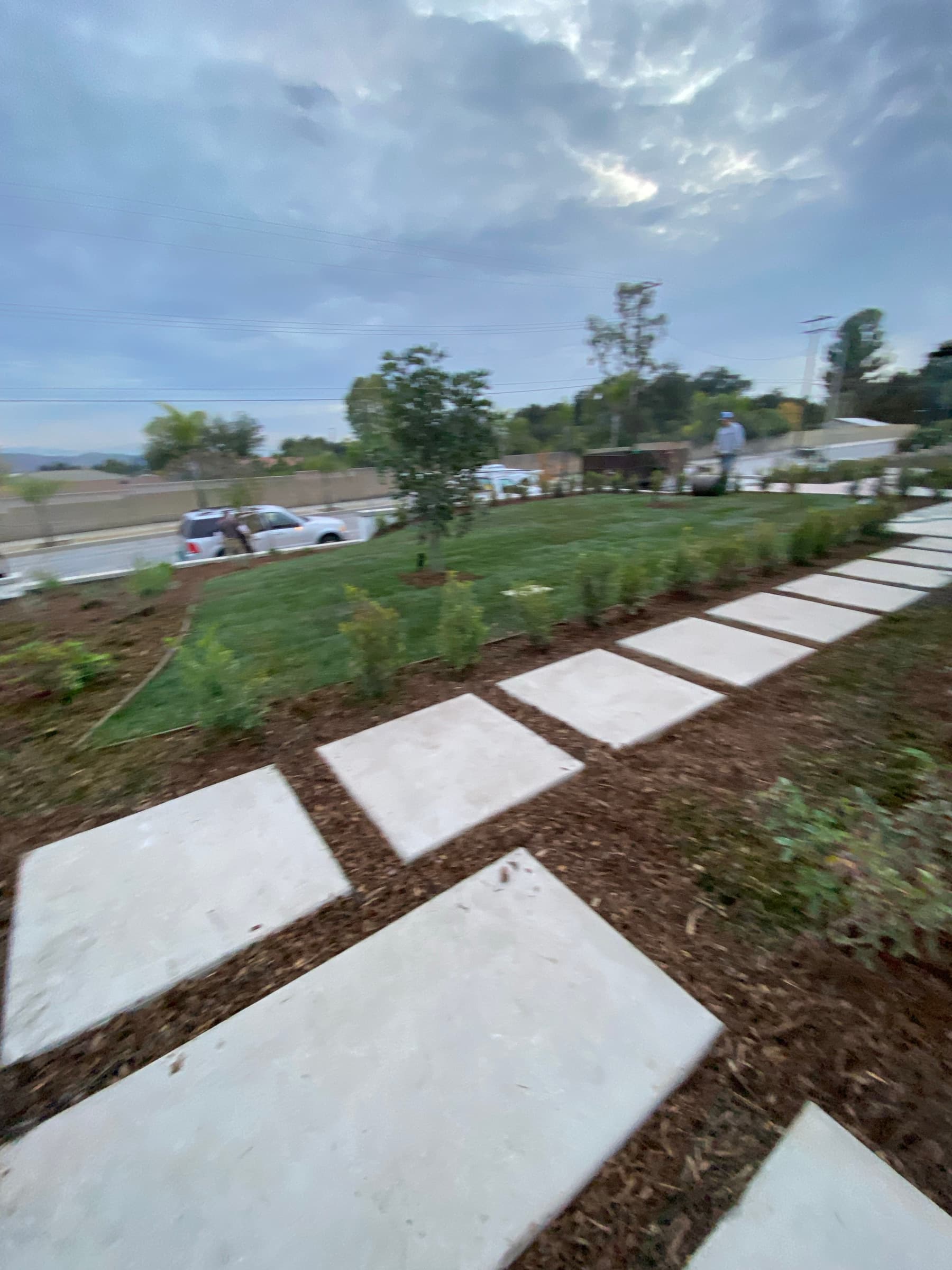
Real grass on a base that actually drains — stripped, amended, graded, and laid tight so it knits instead of stripping.
Read next
- Artificial Turf vs Sod in Southern CaliforniaWater, heat, upkeep, pets, and what each actually costs to own over ten years — an honest comparison from a crew that installs both.11 min read
- Which Grass Survives a Southern California Summer?Warm season versus cool season, what each one costs you in water and winter color, and how many hours of sun your yard actually gets before you choose.10 min read
- Does Artificial Turf Smell With Dogs?Yes if it is never rinsed, no if the base drains and somebody hoses it down. Base permeability, infill choice, and what the maintenance honestly involves.10 min read