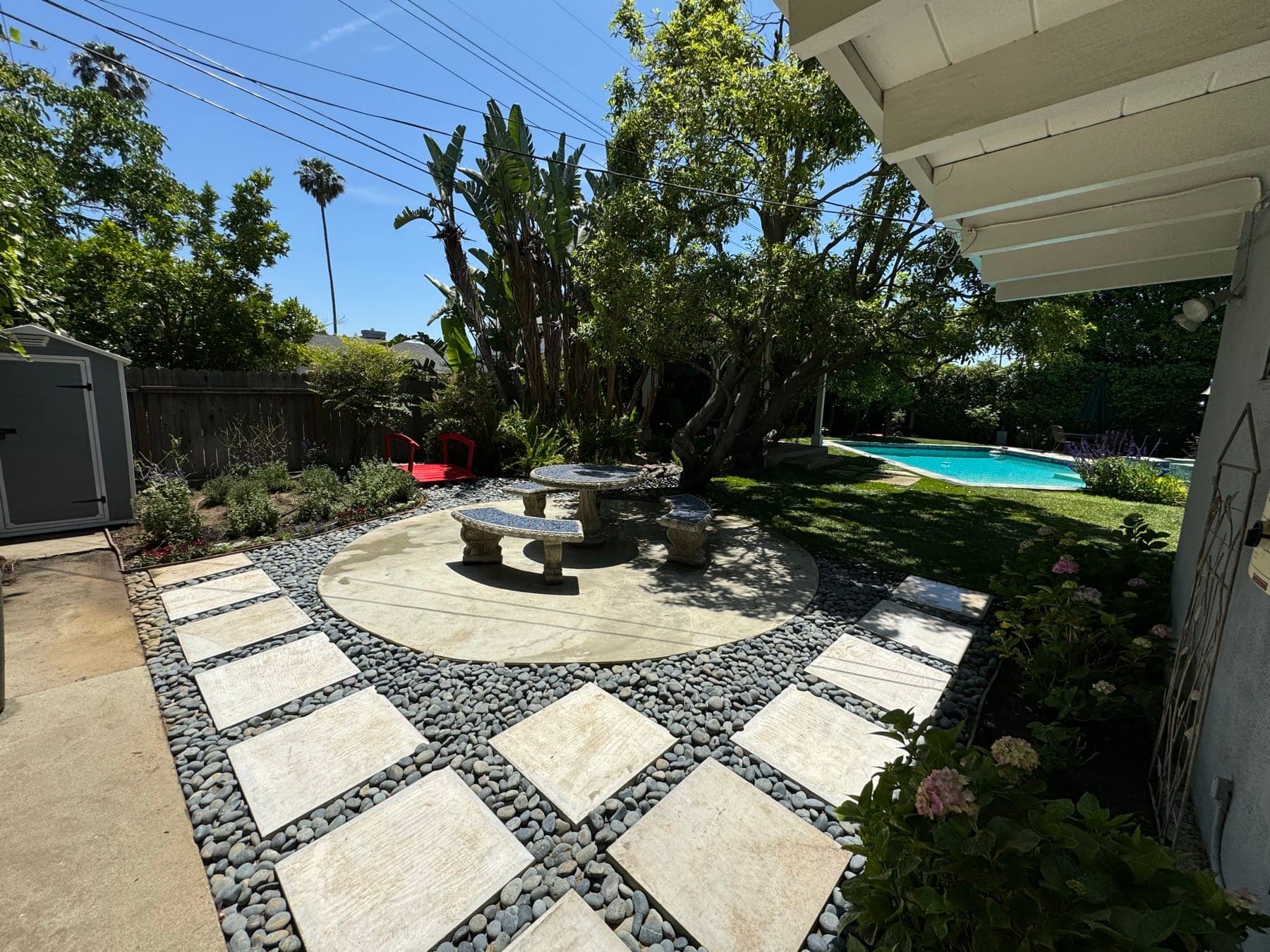
 Design inspiration
Walkway & Step Installation
Entry walks, side yards, and steps with solid footing, correct rise, and edges that stay sharp. Serving San Bernardino and Los Angeles counties.
Walks and steps are the part of a property everyone touches, usually while carrying something, often in the dark. So they get the same base work as a driveway even though nothing heavy ever parks on them: soft soil stripped out, base compacted, reinforcement where the ground moves or the walk spans a soft spot, and a slope that sheds water instead of ponding it against the house.
Steps are where consistency matters most. Every step in a run gets the same rise, and every tread the same depth, because your foot learns the first step and expects the rest to match. One odd step at the top is what catches people. The exact rise and tread dimensions follow what your city enforces, and we confirm them during the estimate. Steps sit on footings dug below grade, never on fill, so the run does not tip or pull away from the landing a few winters later.
Then the details that decide whether it still looks good in five years. Tooled or saw-cut edges that stay sharp instead of crumbling, a nosing you can pick out at a glance, and a finish on treads and landings that is not slick when wet. If a handrail is going in, tell us before the pour and we will set anchors or blockouts in the wet concrete so the rail bolts to something solid instead of into a hole drilled later. And if you want path lighting, say so early: sleeving conduit under the walk takes minutes while the ground is open and a saw cut once it is not.
What’s included
- Stripped subgrade and compacted base under every walk and landing
- Reinforcement where the soil moves or a walk crosses a soft spot
- Footings dug below grade under every set of steps
- The same rise and tread depth through a whole run, matched to what your city enforces
- Non-slick finish on treads and landings, with tooled or saw-cut edges
- Handrail anchors or blockouts set at the pour wherever a rail is going in
- Conduit sleeved under the walk for path and step lighting
- Slope and joint layout that carries water away from the house and foundation
Common questions
What rise and run do you build steps to?
The same one the whole way up, and the one your city enforces. There is a required range for step height and tread depth, and the bigger safety issue is consistency: a single step taller than the rest is what trips people. The exact numbers vary by city — we confirm during the estimate and lay the run out to match.
Do my steps need a handrail?
It depends on how many steps are in the run and where it sits, and that varies by city. We confirm during the estimate. Either way, if a rail is going in, tell us before the pour so we can set the anchors in wet concrete and the rail ends up bolted into something solid.
Can you run lighting along a walkway?
Yes, if you decide before we pour. We sleeve conduit under the walk and stub it up where the fixtures go, then the electrical trade makes the connections. Adding it afterward means cutting the surface you just paid for, so it is worth deciding early even if the lights come later.
My walkway is cracked and uneven. Repair or replace?
If a section heaved off a root or dropped into a soft spot, patching it puts a fresh surface on a base that is still moving and the crack comes back. We would rather cut out the bad sections, fix what is under them, and pour back to a joint line so the repair reads as a panel instead of a scar. If most of the run has gone, replacing it is the better answer.
Tell us about your project
Send a few details about what you want built and we will get back to you to set up a free on-site estimate.