Do You Need to Seal Concrete in Southern California?
Plain concrete here rarely needs sealing; decorative work does. Sealer types, when it helps, when it becomes a maintenance trap, and how to tell which.
· 10 min read
If you have a plain broom-finish driveway or walkway in Southern California, the honest answer is no, you do not need to seal it. It will be fine unsealed for its entire life. Sealing it is optional, it buys you a modest amount of stain resistance, and it signs you up for a maintenance cycle you did not have before.
If you have stamped, colored, stained, or exposed-aggregate concrete, the answer is yes, and you should understand it as an ongoing commitment rather than a finishing step. The sealer is not protecting the concrete so much as protecting the finish — and the finish is most of what you paid for.
The distinction matters because a lot of sealing advice online was written for climates that freeze. Ours does not, and that changes the arithmetic more than anything else in this article.
Who should seal what
| Surface | Seal it? | Why |
|---|---|---|
| Broom-finish driveway | Optional, leans no | Nothing to protect but the concrete itself, which is fine bare |
| Broom-finish walkway or patio | Optional | Same, unless staining under a tree or planter bothers you |
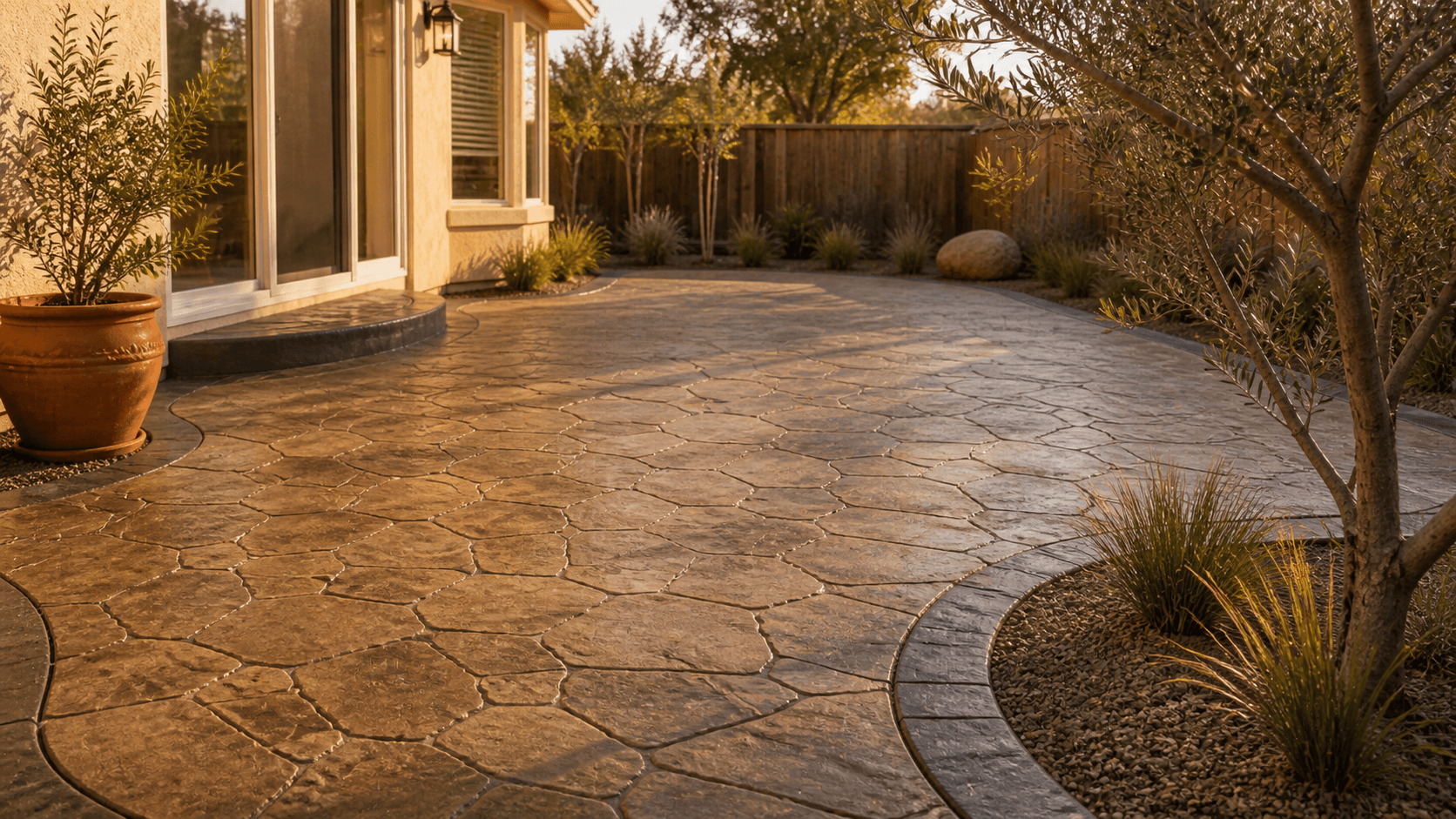
| Stamped or integrally colored | Yes | The color and antiquing are what wear; sealer is what keeps them deep |
| Acid-stained or dyed | Yes, and non-negotiable | The stain is in the top layer and unprotected it will not last |
| Exposed aggregate | Recommended | Deepens the stone color and locks marginal stones |
| Pool deck | Usually, with a grit additive | The wrong sealer here is worse than none |
| Garage floor | Yes | Oil, hot tires, and the one surface where a coating genuinely pays |
| RV pad | Optional, leans yes | Sustained drips, and a working surface that collects marks |
What sealer actually does
A sealer reduces how much liquid the surface absorbs. That is the mechanism behind every benefit it has.
Stain resistance. Oil, transmission fluid, barbecue grease, wine, fertilizer, leaf tannin. On unsealed concrete these soak into the surface pores and are difficult to fully remove. On sealed concrete they sit on top long enough that you can get to them. This is the strongest practical argument for sealing anything.
Color depth. Sealed decorative concrete looks the way it did the day it was poured — the color reads saturated instead of chalky. That "wet look" is entirely the sealer. Let it wear off and the same slab looks tired even though nothing has actually degraded.
Slower surface wear. The top layer of cement paste is the softest part of the slab. A coating takes traffic instead of the paste.
Efflorescence and mineral spotting. Sprinkler overspray in hard water leaves white mineral deposits. A sealed surface releases them more easily.
Now the list of things sealer does not do, because this is where expectations get set wrong:
- It does not prevent cracking. Nothing applied to a surface affects shrinkage, joint spacing, base support, or steel placement.
- It does not prevent settlement.
- It does not make concrete waterproof. Water still moves through a slab from below.
- It does not stop ultraviolet fade entirely. It slows the appearance of fading. Sun still wins eventually.
- It does not fix a bad finish. Sealer makes an even surface look better and an uneven surface look shinier and still uneven.
Why Southern California is different
In a cold climate, the case for sealing is straightforward: water gets into the surface, freezes, expands, and pops the top layer off. Freeze-thaw damage is real, cumulative, and preventable, and it is why so much sealing advice sounds urgent.
We do not have that. There is no freeze cycle working on your driveway, which removes the single strongest reason to seal plain concrete.
What we have instead:
- Ultraviolet exposure, relentlessly, most of the year. This is a color problem, not a strength problem, and it is the main argument for sealing decorative work.
- Heat, which cooks sealers as much as it cooks anything else and shortens their life on a west-facing driveway.
- Hard water, from irrigation overspray, leaving mineral deposits.
- Oil, which is the same everywhere.
- Long dry spells followed by concentrated rain, which moves accumulated surface grime around rather than washing it away steadily.
None of those threaten the structure. All of them threaten appearance. So the honest framing is that in this climate, sealing is a cosmetic decision, not a protective one — with the exception of a garage floor, where oil and hot tires make it functional.
The maintenance trap
Here is the part that turns people against sealing, and it is worth understanding before the first coat rather than after the third.
Unsealed concrete degrades gracefully. It gets a little darker in the traffic lines, picks up some stains, and looks like a driveway. It never reaches a state where you have to do something. There is no maintenance cliff.
Film-forming sealed concrete does not degrade gracefully. The film wears where traffic concentrates — tire tracks, the path to the front door — and stays intact everywhere else. So the surface develops a glossy border around a dull center, which reads as neglect long before anything is actually wrong. Now you have to recoat, and you have to keep recoating, and each cycle asks for the surface to be clean and completely dry first.
Coats build up. Every recoat adds thickness. After enough cycles a film sealer starts looking plastic, traps whatever dirt was on the surface under the new layer, and eventually has to be stripped rather than recoated. Stripping is chemicals, scrubbing, waste, and a full day or more of labor.
Trapped moisture goes white. Seal a slab that is not dry through — or seal one that takes moisture from below because it sits on damp soil with no break beneath it — and the film goes cloudy or milky. It does not dry out on its own. It gets stripped.
Hot tires lift it. Tires get hot, soften an acrylic film, and pull it up when the car cools and the rubber releases. You get patches of missing sealer in the exact spot the car parks. This is common on driveways and it is the single best reason to be careful about sealing a driveway you park on daily.
None of this means "do not seal." It means: seal for a reason, on a surface where the reason applies, with a sealer chosen for the exposure, and understand you are starting a cycle.
The types, and what they are for
| Type | How it works | Look | Typical life | Notes |
|---|---|---|---|---|
| Penetrating (silane/siloxane) | Soaks in, lines the pores, works from inside | No sheen, looks unsealed | Long | No film to peel, no slip penalty, hard to get wrong |
| Silicate densifier | Reacts with the concrete to harden the surface | None | Very long | Hardens and dusts less; minimal stain resistance |
| Acrylic, water-based | Thin film on the surface | Low to medium sheen | Short to medium | Easy to apply and recoat, less odor |
| Acrylic, solvent-based | Thin film, penetrates slightly deeper | Wet look, richer color | Medium | The classic stamped-concrete look; strong odor during application |
| Urethane | Tough film | Gloss or satin | Long | Durable but less forgiving; usually over a primer coat |
| Epoxy | Thick, hard coating | Gloss | Long indoors | Garage floors and interiors; yellows and chalks in direct sun |
The practical shortlist:
- Plain concrete you want protected without committing to a cycle: penetrating. It is the low-drama choice, it will not peel, it will not go white, and it does not make anything slippery. It also will not make your driveway look wet and rich, because it is not supposed to.
- Stamped and decorative: solvent-based acrylic is the standard for a reason — it produces the depth the finish was designed around and it recoats over itself readily.
- Garage: epoxy or urethane, and worth doing properly with the surface prepared.
- Pool deck: whatever you use, with a grit additive, and not high gloss.
When to apply the first coat
Not early. This is the mistake that produces the most callbacks in the trade.
The slab has to be strong enough and dry enough, and dry lags strength by a long way. A thick slab in cool weather can hold moisture well past a month. Sealing over that moisture is what produces the milky finish, and there is no repair short of stripping.
Two other things get confused here. A curing compound applied at the pour is not a sealer — it is a temporary membrane to hold water in during the first days, and some of them must be removed before a real sealer goes on. And a slab that has been rained on, or hosed, or had sprinklers running near it, is not dry the following morning no matter how it looks.
A contractor who says "we will come back and seal it once the slab is dry" is telling you they have done this before. One who seals stamped work on day ten because the schedule says so is not.
How often, and how to tell
The site-level answer: when water stops beading and the color looks flat.
That is a genuinely useful test. Splash a cup of water on a few areas — a traffic line and a protected corner. If it beads up and sits, the sealer is working. If it soaks straight in and darkens the concrete, the sealer is gone in that spot.
Expect a shaded patio to go substantially longer than a west-facing driveway. Expect the tire tracks to go first. Expect a sealed pool deck to need attention sooner than a covered patio, because it is wet constantly and gets scrubbed.
Doing it right, when you do it:
- Clean first, properly. Any dirt left on the surface is dirt sealed under the new coat, permanently.
- Let it dry completely. Days, not hours, after a wash.
- Two thin coats beat one thick one. Thick coats trap solvent, bubble, and stay soft.
- Do not seal in direct hot sun. The coat flashes off before it can level and you get bubbles and lap marks. Early morning or a cool overcast day.
- Do not puddle it in low spots. Where it pools, it stays glossy and soft.
What a sealer problem looks like
Most of what people call "the concrete failed" on decorative work is actually the sealer failing, which is better news than it sounds — the slab is fine.
- White or milky haze, worst after rain or a wash. Moisture trapped under the film. Sometimes a solvent recoat re-opens the film and lets it out; often it is a strip and redo.
- Bubbles or a sandpapery texture across a whole area. Applied too thick, or applied in hot sun so the surface skinned before the solvent left.
- Glossy edges, dull center. Normal wear in the traffic lines. This is the recoat signal, not a defect.
- Bare patches where the car parks. Hot tire pickup. A different sealer chemistry, or accept it and stop sealing that area.
- Peeling in sheets. Too many coats, or a coat applied over dirt so it never bonded. Strip.
- Dark blotches that will not wash out. Something soaked in before the surface was sealed, or dirt sealed under a coat.
- Suddenly slippery when wet. A gloss film over shallow texture. Fixable, by adding grit at the next coat.
The pattern in that list: almost every one traces back to application conditions rather than product choice. Clean, dry, thin, cool, two coats. Nearly everything else is a consequence of skipping one of those.
Where we would tell you not to bother
- A plain broom driveway you park on daily. The stain benefit is modest, the hot-tire risk is real, and unsealed is a perfectly good permanent state.
- Any surface where nobody in the household will maintain the cycle. A sealed surface that is never recoated ends up looking worse than one that was never sealed, and the recovery is stripping.
- A slab with a moisture problem from below. Fix the moisture, or accept the surface as it is. A film over a wet slab fails in a way that is loud and expensive.
- As a repair. Sealer on a cracked, spalled, or settled slab is a coat of gloss over a problem. Some contractors do this before a sale. It does not last a season.
What to ask
- Which sealer, penetrating or film? This is the fork in the road and it determines everything that follows.
- What is the maintenance interval, and do you come back and do it? A real interval, and a real answer about who performs it.
- When is the first coat going on, and how do you know the slab is dry? "Once it is dry" beats a date on a calendar.
- Is there grit in it? On anything sloped or near water, there should be.
- What happens when it wears in the tire tracks? Recoat over itself, or strip first? The honest answer depends on the product and how many coats are already there.
- If I do nothing, what actually happens? On plain concrete, the honest answer is "not much." A contractor willing to say that is worth listening to on the surfaces where sealing does matter.
Stamped, stained, and patterned finishes in ashlar, slate, and custom textures — the premium look without paver upkeep.
Read next
- How Thick Should a Concrete Driveway Be?Four inches, six, or more — what actually decides driveway thickness, why the base matters more than the number, and where RV pads differ.10 min read
- Why Concrete Cracks, and Which Cracks MatterAll concrete cracks. How to tell a harmless shrinkage hairline from a crack that means the base under your slab has failed, and what to do about each.12 min read
- How Long Before You Can Drive on New Concrete?Foot traffic in about a day, vehicles in about a week. Why the 28-day figure is misunderstood, what damages young concrete, and how heat changes a cure.11 min read