How Thick Should a Concrete Driveway Be?
Four inches, six, or more — what actually decides driveway thickness, why the base matters more than the number, and where RV pads differ.
· 10 min read
Ask five contractors how thick a concrete driveway should be and you will get "four inches" from most of them, "six" from a couple, and a shrug from the rest. All of those answers can be right, and none of them is the part that decides whether your driveway is still flat in fifteen years.
Thickness matters. It just matters less than what is underneath it, and a lot less than most people are told. Here is how we actually decide, and what to ask whoever gives you a number.
The short answer
For a normal residential driveway carrying cars, a light truck, and the occasional delivery van, four inches of concrete over a properly prepared base is the standard build and it is genuinely adequate. Not a compromise, not a corner cut — adequate.
You go thicker when the loads change:
| Use | Typical slab | Why |
|---|---|---|
| Cars and light trucks | 4" | Standard residential loading |
| Regular heavy pickups, dual-axle trailers | 5" | More frequent point loads, heavier axles |
| RV pad, boat, box truck | 6" or more | Sustained weight parked in one spot for months |
| Approach apron at the street | 6" typical | Everything entering the property crosses it |
The apron is the piece people forget. It is the strip between the sidewalk or curb and your property line, and every vehicle that ever visits your house drives over it — including the trash truck that clips the corner every week. It gets built heavier than the driveway behind it as a matter of course.
Why the base decides more than the slab
A concrete slab does not carry your truck. It spreads your truck's weight out over the ground, and the ground carries it. That is the whole job. Concrete is enormously strong in compression and weak in tension, which means it fails by bending — and it only bends when the support under it is uneven.
Put a four-inch slab on a uniformly compacted base and it is a floor. Put a six-inch slab on soft spots and voids and it is a bridge, and bridges made of unreinforced concrete crack.
Three things have to be true down there:
- The soft material is gone. Topsoil, old root mat, buried debris, and the fill a builder pushed around thirty years ago all compress under load. It comes out before anything goes in.
- The base is compacted in lifts. You cannot dump eight inches of aggregate and run a plate compactor over the top of it — the bottom half never densifies. It goes in a few inches at a time, each layer compacted before the next.
- It is uniform. A base that is beautifully compacted in three places and soft in a fourth gives you a slab that is supported in three places. The crack will find the fourth.
This is the least visible and most expensive part of the job, which is exactly why it is where corners get cut. When a driveway fails in five years, the base is almost always the reason.
Rebar or wire mesh
For anything carrying a vehicle: rebar, tied on a grid, and chaired up so it sits inside the slab rather than on the dirt.
Steel does nothing lying on the subgrade. Concrete cracks in tension, tension develops at the bottom of a bending slab and across the width of a shrinkage crack, and reinforcement has to be in the concrete to resist any of it. Steel under the concrete is a rust stain waiting to happen.
Wire mesh is not inherently useless — it just does not survive the pour. In theory a crew lifts it into position as the concrete goes in. In practice it gets walked down onto the base in the first five minutes and stays there. Rebar on chairs is not more effective because rebar is magic; it is more effective because it is still in the right place when the truck leaves.
What reinforcement actually buys you is not a crack-free driveway. It is a driveway where the cracks that do form stay tight, stay level across the joint, and never turn into two slabs at different heights.
Control joints, and where the cracks go
Concrete shrinks as it cures. It will crack. The only question is whether it cracks where you chose or where it felt like it.
Control joints are cuts about a quarter of the slab depth, placed so the slab is divided into roughly square panels. They create a deliberate weak line, so the shrinkage crack forms down inside the cut where nobody sees it instead of wandering diagonally across the middle of your driveway.
Two things matter about them:
- Timing. They get saw-cut on a schedule — early enough that the slab has not already relieved itself somewhere else, late enough that the edges do not ravel. Miss the window and you get a random crack next to a perfectly good joint.
- Layout. Panels want to be close to square. Long, narrow panels crack across the middle regardless of the joints around them.
Drainage is part of the structure
Water is the other half of this. It undermines base material, it collects against foundations, and in the joints it accelerates everything that was already going to go wrong.
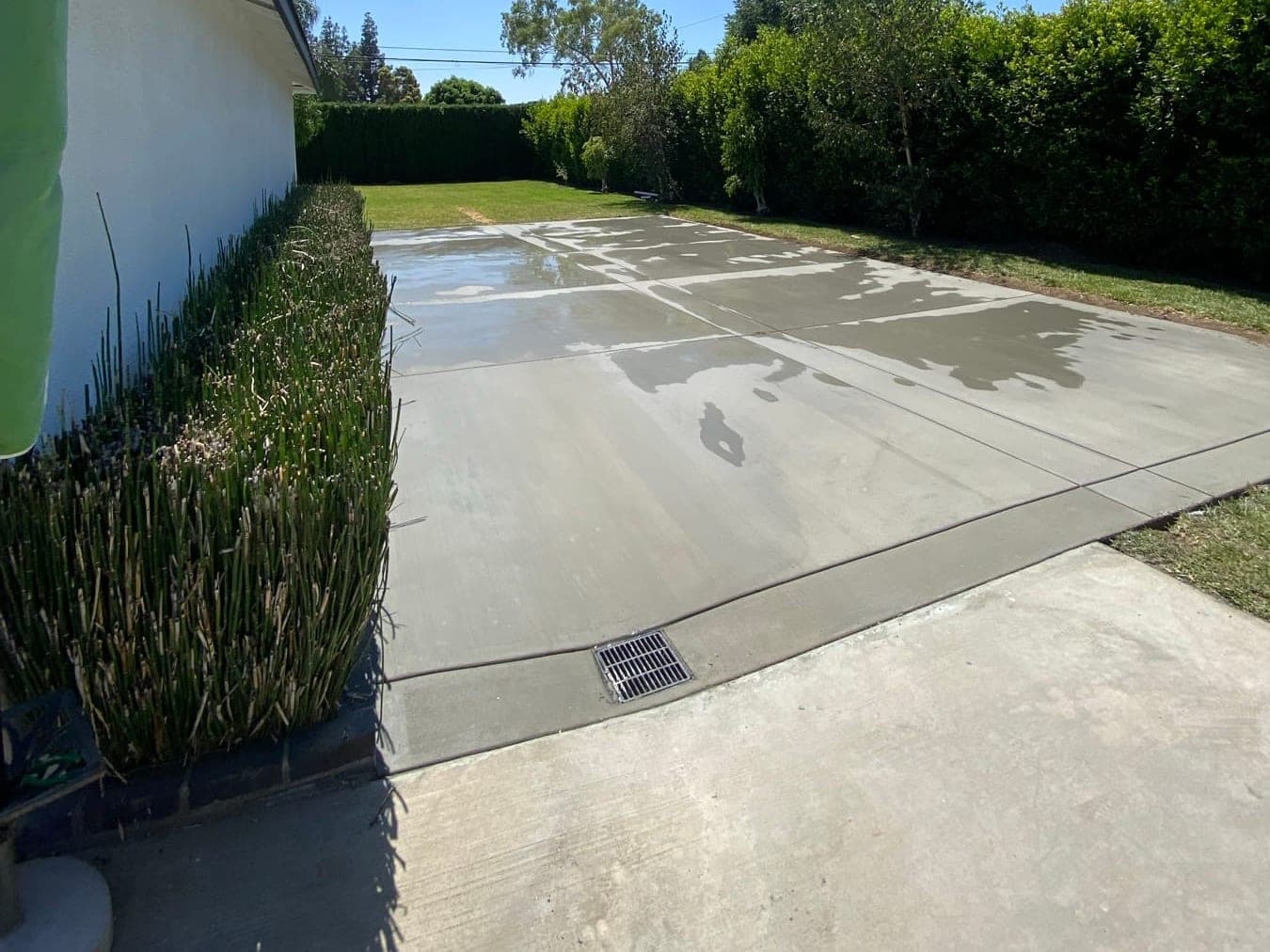
A driveway is graded to shed water — to the street, to a channel drain, to a swale, anywhere except back toward your garage or your house. The usual working figure is a quarter inch of fall per foot of run, which is enough to move water and shallow enough that nobody notices they are walking on a slope.
That fall gets laid out before the forms go in, not discovered afterwards. Retro-fixing drainage on a finished slab means cutting it up or adding a drain to catch a problem that should not exist.
RV pads and anything that parks for months
A parked RV is a different problem from a moving truck. A vehicle driving across a slab applies its load and takes it away. A coach on jacks applies concentrated point loads to the same four spots continuously, sometimes for a whole season.
So RV pads get a thicker slab, heavier steel, and particular attention to the base under the jack points. They also get their drainage thought about separately, because a pad that holds water under a vehicle parked on it for six months is a pad that will move.
They also want a much longer wait before they are loaded. The week that is fine for a car is not fine for a coach on jacks: give a new pad roughly a month before parking anything that heavy on it, and longer in cool weather. This is the one place the familiar 28-day figure genuinely applies.
What actually fails
Almost everything we tear out failed for one of these reasons, and thickness is rarely on the list:
- Base was never compacted, or was compacted in one deep lift. The slab settles unevenly and cracks across the low spot.
- Soft material was left in place. Same result, slower.
- Steel on the dirt. The cracks that form open up and the panels move independently.
- Joints cut late or spaced wrong. Random cracking next to perfectly good joints.
- Water running the wrong way. Base washes out from underneath, usually at the edges first.
- Loaded too early. Concrete keeps gaining strength for weeks after it stops looking wet.
What to ask before you sign
You do not need to know concrete to ask useful questions. These four will tell you a lot:
- How deep are you excavating, and what are you putting back? You want a number for the base depth and a statement that it goes in compacted in lifts.
- What reinforcement, and how is it held up? "Rebar on a grid, chaired" is the answer you want.
- Where is the water going? They should be able to point at it.
- When are the joints being cut, and where? Anyone who has not thought about joint layout has not thought about your driveway.
If the answers are vague on all four but the quote is confident about thickness, you have learned something.
How long before you can drive on it
Stay off it on foot for the first day or so, and keep cars and light trucks off for about a week. Concrete does not stop curing when it stops looking wet — it keeps gaining strength for a long time afterwards, and the first week is when it is most vulnerable to point loads. Anything heavier, and anything that will sit in one spot for months, waits a good deal longer — see the RV pad section above.
We give you the specific date at the pour and leave barricades up so nobody has to guess. The most common early damage we see is a delivery driver reversing onto a four-day-old slab because nothing told them not to.
Broom-finish and decorative driveways, approach aprons, and reinforced RV pads that carry the load and drain right.
Read next
- Why Concrete Cracks, and Which Cracks MatterAll concrete cracks. How to tell a harmless shrinkage hairline from a crack that means the base under your slab has failed, and what to do about each.12 min read
- How Long Before You Can Drive on New Concrete?Foot traffic in about a day, vehicles in about a week. Why the 28-day figure is misunderstood, what damages young concrete, and how heat changes a cure.11 min read
- Broom, Smooth, or Exposed Aggregate?Broom for almost anything outdoors, smooth for indoors, exposed aggregate where grip matters most. Slip, heat, cleaning, and where each finish belongs.11 min read