How Deep Should a Paver Base Be?
Base depth by use, why compaction happens in lifts, and the reason most failed paver jobs failed underneath rather than on top.
· 10 min read
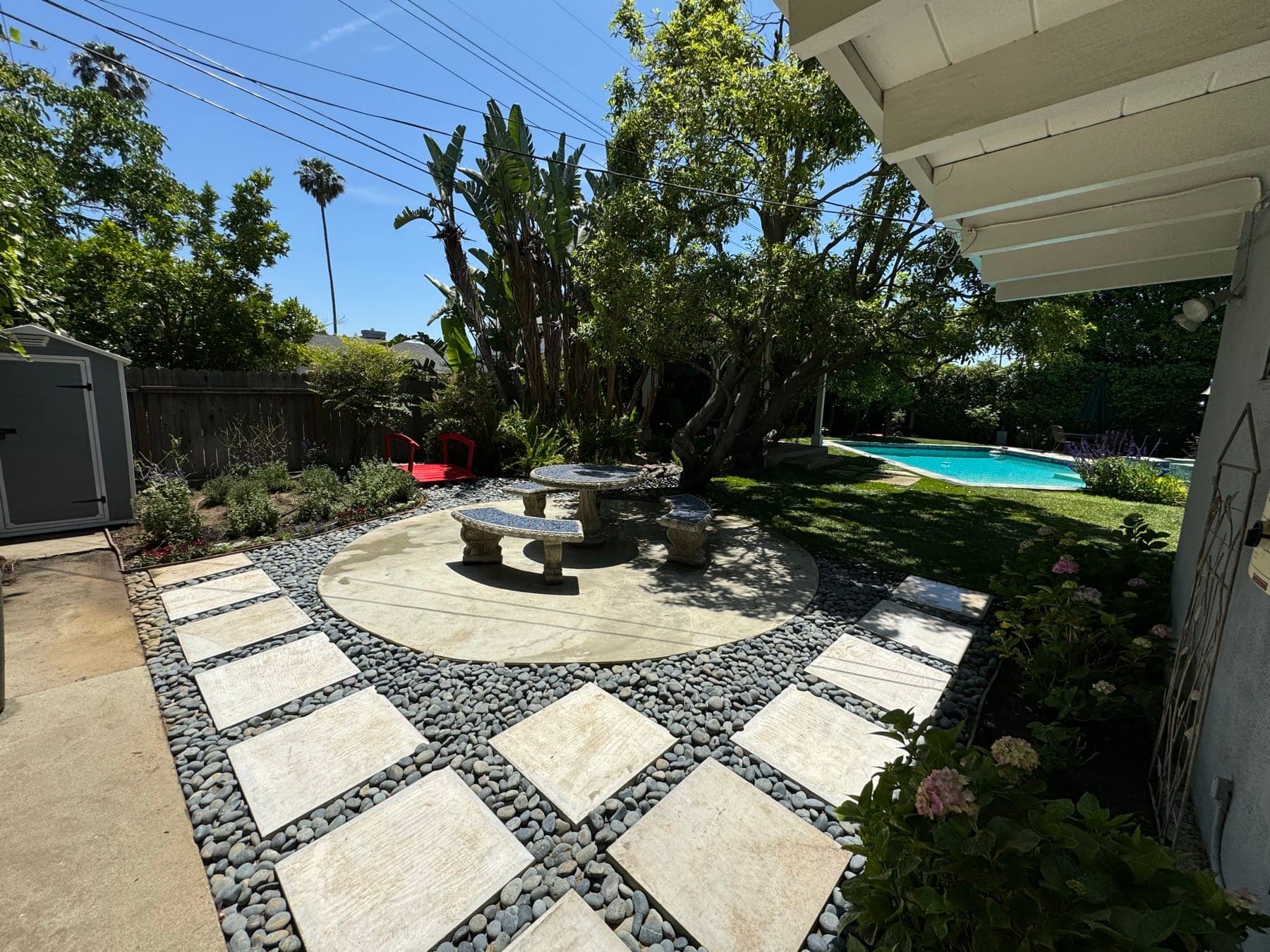
Most failed paver jobs did not fail at the paver. The paver is a manufactured concrete unit that will outlive everyone reading this. What failed was somewhere in the six to twelve inches underneath it, and by the time you can see the problem on the surface, the fix is to take the whole thing up.
So the question is worth asking properly.
The short answer, by use
| Use | Compacted base | Bedding sand |
|---|---|---|
| Walkway, patio, foot traffic only | 4–6" | 1" |
| Driveway, cars and light trucks | 8–12" | 1" |
| Heavy or repeated vehicle loads | 12"+ | 1" |
Those are working ranges, not a spec sheet. The number moves with your soil — a sandy, free-draining subgrade needs less base than heavy clay, which holds water, softens, and moves. On expansive clay we go deeper than the table suggests and pay more attention to drainage than to depth.
The bedding sand row does not move, and that surprises people. More on that below, because it is the single most common way a paver job gets wrecked by someone trying to be helpful.
What the base is actually doing
An interlocking paver surface is a flexible pavement. It is not a slab — it is thousands of individual units that transfer load sideways to their neighbors through the sand in the joints, and downward into the base.
That flexibility is the whole advantage. A concrete slab spans, so it cracks when its support goes uneven. A paver field does not span; it conforms. Ground movement that would crack a slab shows up in a paver surface as a gentle undulation, and individual pavers can be lifted and reset without a saw.
But the flexibility only works if the layer beneath is uniform. Pavers spread load — they do not carry it. Every bit of strength comes from the compacted aggregate under them.
Compaction happens in lifts, or it does not happen
This is the part that separates a base that lasts from a base that looks identical on day one and settles in year two.
You cannot dump ten inches of aggregate, run a plate compactor over the top, and call it compacted. Compaction energy only travels so far down. The top few inches densify beautifully; the bottom of the pile stays loose, and it consolidates later — under your car, unevenly, over the following winters.
Base goes in a few inches at a time, each lift compacted before the next is placed. A ten-inch base is three or four passes of place-and-compact, not one. It takes longer and it is completely invisible in the finished job, which is precisely why it is where cost gets taken out of a quote.
The subgrade gets compacted too, before any aggregate goes on it. A perfectly built base sitting on soft native soil is a well-built base that settles.
The one-inch bedding course
Bedding sand is a setting bed, not a levelling layer. Its job is to give each paver a consistent surface to seat into so the tops line up. That is all.
It is screeded to one inch and left uncompacted until the pavers are down. Then the whole field is compacted together, which drives the pavers into the sand and starts the interlock.
Two ways this goes wrong, and both are extremely common:
- Using sand to fix a bad base. A low spot in the aggregate gets filled with extra sand instead of more base. Sand does not compact like base and it does not stay put — it consolidates and migrates, and that patch drops. Every dip in an otherwise good paver field is usually a place where sand was doing a base's job.
- Compacting the bedding before laying. Compacted bedding sand cannot accept the pavers evenly, and the surface ends up uneven in a way that will not screed out.
If your installer is screeding two or three inches of sand, they are not building a base. They are hiding one.
Edge restraint, or the field walks
A paver field is only interlocked as long as its perimeter is held. Take away the edge and the outermost course pushes outward under load, the joints open, and it works its way inward — slowly at first, then not.
Edge restraint gets pinned into the base, not into soil beyond it. Restraint spiked into loose ground on the far side of the base is decorative. This is why the excavation runs wider than the finished paver area: there has to be compacted base under the edging.
Driveway edges take the most abuse, particularly where a wheel routinely tracks over the same corner turning in from the street. That corner is worth over-building.
Joint sand does structural work
The sand between pavers is not grout and it is not cosmetic. Load transfers from one paver into its neighbors through that joint. Joints that are empty are joints that are not transferring anything, and units start to rock individually.
The field gets compacted with sand in the joints, then swept and compacted again, because the first pass always drops the level. Polymeric sand binds and resists washout and weeds; plain sand is cheaper and needs topping up. Either can be right. Empty joints are never right.
Expect to top joints up once in the first year. That is normal settlement, not a defect.
Drainage, again
Water is the destroyer here as it is everywhere else. A paver surface is permeable at the joints by design, so water goes through it and reaches the base. That is fine — as long as the base and subgrade are shaped to move it somewhere.
What kills a base is water sitting in it. Saturated aggregate loses strength, fines migrate, and the whole layer consolidates unevenly. So the subgrade gets a fall on it, not just the surface, and low points get a drain rather than a hope.
How to read a quote
Comparing paver quotes is hard because the visible part — the paver itself — is the part that varies least. Ask about the invisible part:
- How deep is the excavation, and what base depth are you placing? A number, for your use.
- How is it compacted? You want to hear "in lifts."
- How thick is the bedding sand? One inch. If the answer is two or three, ask why.
- What edge restraint, and what is it pinned into? Base, not soil.
- Where does the water go? They should point.
- Is the subgrade compacted before base goes down? It should be.
Two quotes describing the same pavers can be different jobs entirely, and the difference is entirely under the surface.
What failure looks like
- Dips and low spots in the field — base not compacted in lifts, or sand used to level.
- Edges spreading, joints opening at the perimeter — edge restraint failed or was never in base.
- Individual pavers rocking — joint sand gone.
- A settled patch in one area — soft material left in the subgrade, or water collecting there.
- Ruts where wheels track — base too thin for the actual loading.
The good news, and the real argument for pavers over a slab: every one of these is repairable. The units come up, the base gets fixed, the same pavers go back down. There is no patch and no color-matched pour. A slab with the same problem is a demolition job.
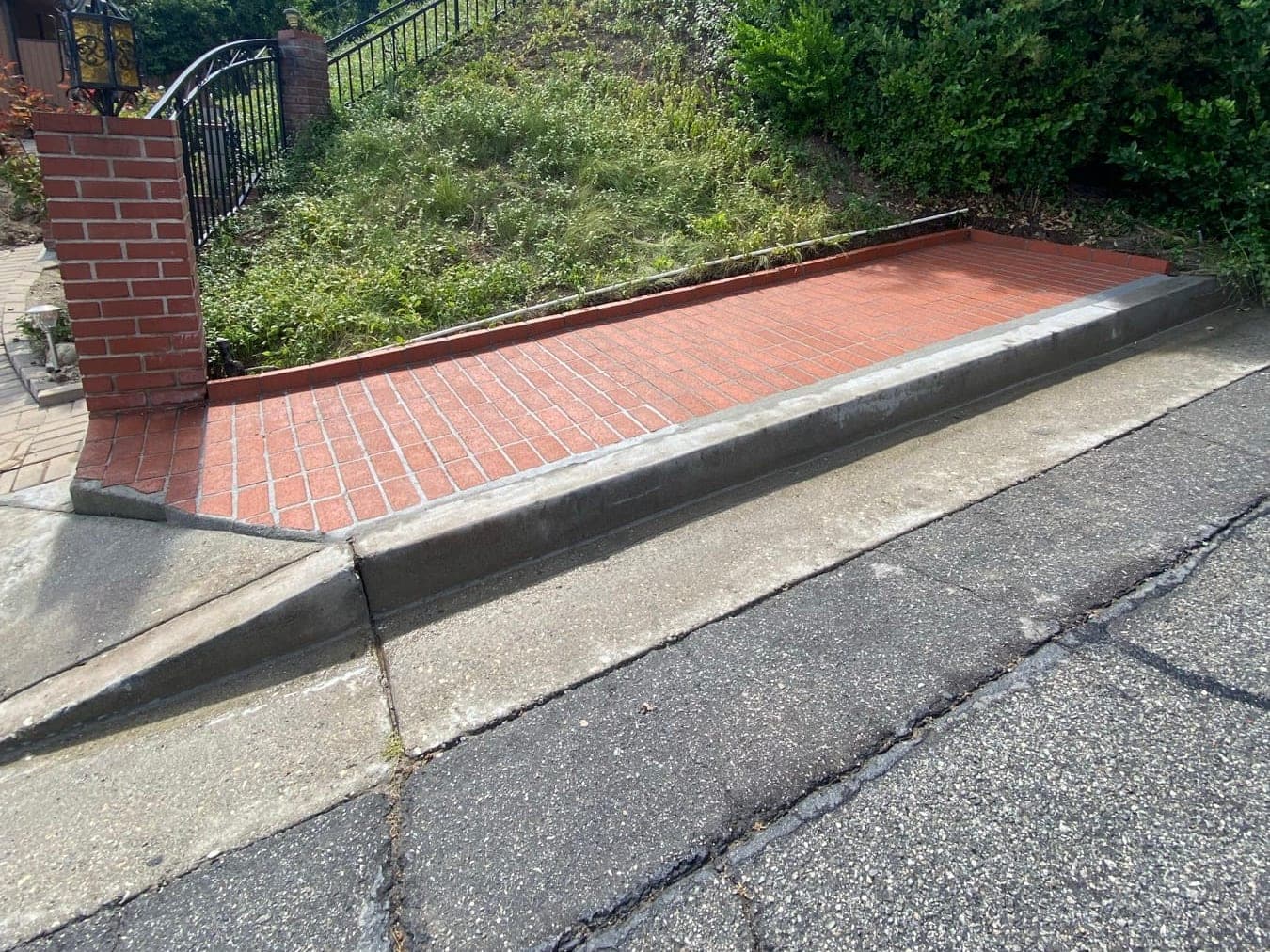
Interlocking paver systems set on an engineered base: driveways, patios, and courtyards that flex without cracking.
Read next
- Why Pavers Sink, and What Fixing It InvolvesPavers do not fail; the base under them moves. Read the dip to find the cause, and what an honest repair really involves, from lifting to re-sanding it.11 min read
- Do Retaining Walls Need Drainage?Yes, every one of them. Hydrostatic pressure, the gravel chimney, filter fabric, perforated pipe to daylight, and why almost every failed wall failed wet.11 min read
- When a Retaining Wall Needs an EngineerHeight is only part of it. Surcharge, the slope above and below, tiering, geogrid, and the failure modes an engineer checks that nobody else is checking.10 min read